



Important Changes for Landlords: New Property Registration Rules Coming to the West Midlands
Acres Residential Lettings explains what landlords need to know, the costs involved and the important deadlines approaching in 2027.
If you own a rental property in Sutton Coldfield, Four Oaks, Walmley, Great Barr or elsewhere in the West Midlands, there are some important changes on the horizon that you need to be aware of.
As part of the government's Renters' Rights Act 2025, a new national landlord and rental property registration service is being introduced across England.
The West Midlands will be the first region to participate, with registration opening on 15 December 2026.
Here at Acres Residential Lettings, we want to make sure our landlords and local property investors are fully informed and have plenty of time to prepare.
Whilst the new arrangements introduce additional responsibilities, the process should be relatively straightforward for landlords who have their property information and compliance documentation organised.
With that in mind, we've put together this guide explaining what the changes mean and what you should do next.

When Do Landlords Need to Register?
The new government service will be introduced region by region, beginning in the West Midlands.
For landlords with qualifying properties in our area, the important dates are:
- 15 December 2026: Registration opens.
- 14 March 2027: Deadline for registering qualifying West Midlands rental properties.
Landlords must complete the required registration before midnight on 14 March 2027.
The remainder of England will follow in stages throughout 2027, with the final regional deadline falling on 14 November 2027.
If you own rental properties in more than one region, you will need to ensure each is registered by the deadline applicable to its location.
Our advice is simple: don't leave things until the last minute.
Who Needs to Register?
The new requirements generally apply to private landlords letting residential properties in England under assured or regulated tenancies.
This includes individual landlords as well as companies, trusts, charities and other qualifying organisations.
Where a rental property is jointly owned, each joint landlord will have separate registration requirements.
The rules also apply to qualifying Houses in Multiple Occupation (HMOs), although a licensed HMO normally requires one registration for the whole property rather than individual registrations for each room.
During the initial rollout, the requirement focuses on properties currently let or becoming let. The government intends to extend registration requirements to vacant properties before they can be advertised in a later phase.
There are limited exceptions, so landlords with unusual tenancy arrangements should check the official guidance.
How Much Will Registration Cost?
The government has confirmed an annual registration fee of £65 per rental property.
This is a property fee rather than a charge for registering as an individual landlord, meaning someone with several rental properties will pay a separate annual fee for each one.
However, the government has introduced a reduced initial payment during the registration rollout.
For example, its published guidance indicates that a landlord registering a property on 15 December 2026 would initially pay just £5.34 for that property, with the usual annual fee becoming payable at renewal.
There is no VAT on the fee, and the government confirms that it is tax-deductible, subject to the relevant tax rules.
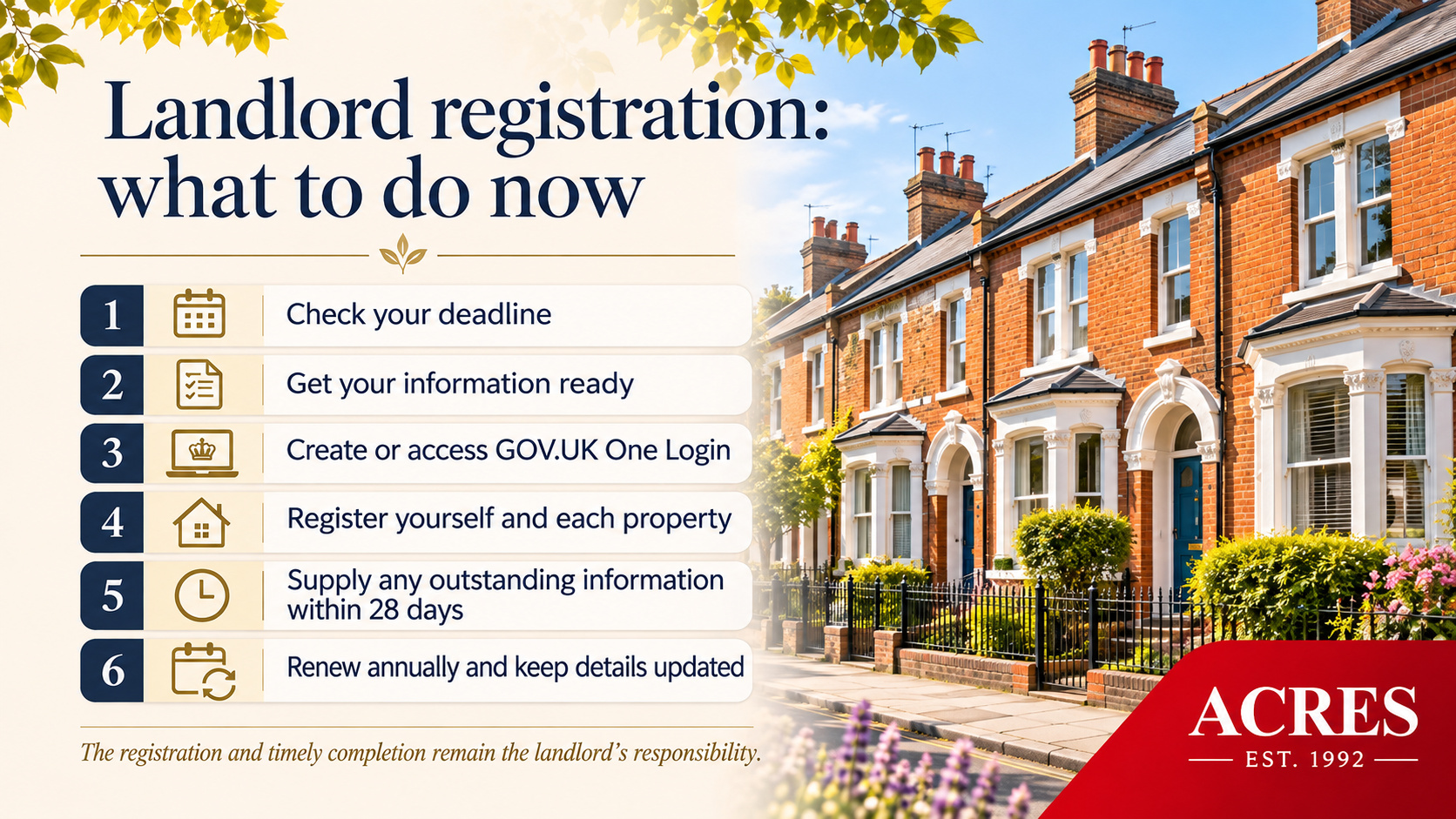
Registration must then be renewed annually, and landlords should ensure their records remain accurate and up to date.
Download our full Landlord Registration Guide
What Information Will Landlords Need?
One of the most important things landlords can do now is make sure their property records are organised.
The registration process will require information covering several areas, including:
- Landlord details, contact information and any joint ownership arrangements.
- Property addresses, number of bedrooms and rental status.
- Tenancy information, including rental payments and occupancy.
- Managing agent details, where applicable.
- Gas safety documentation, where required.
- Electrical safety certificates.
- Energy Performance Certificate (EPC) information.
- Relevant HMO, additional or selective licensing details.
Landlords will use GOV.UK One Login to access the service, although a paper-based alternative will be available for those unable to use the digital system.
Once the initial property registration has been started and the fee paid, landlords will have up to 28 days to supply any outstanding information.
It is important to meet this timescale, as incomplete records may become inactive, potentially placing landlords in breach of their legal obligations.
Information that changes or expires must also be updated within 28 days.
What Happens If a Landlord Doesn't Register?
The government has introduced financial penalties to encourage compliance with the new requirements.
Landlords who fail to register themselves and their qualifying properties could face penalties of up to £7,000.
More serious or repeated breaches, including knowingly or recklessly providing false or misleading information, could result in penalties of up to £40,000.
In certain circumstances, tenants may also be able to apply for Rent Repayment Orders.
Clearly, these are matters landlords should take seriously.
However, our view at Acres is that landlords who prepare in advance, maintain appropriate compliance records and complete their registrations on time should be well placed to manage the new requirements.
Can Acres Residential Lettings Help?
Absolutely.
As a long-established local letting agent, we understand that landlords already have numerous obligations to manage, from property maintenance and safety certification to changing legislation.
Our experienced Residential Lettings team is committed to helping landlords understand these additional requirements.
For properties managed by Acres, we can assist by identifying relevant information already held within our management records, helping locate compliance documentation and, where agreed and authorised, submitting certain information through the government's letting-agent arrangements.
There is, however, an important distinction.
The landlord remains legally responsible for registering themselves and their rental properties, paying the relevant fees and ensuring that all information is submitted within the required timescales.
A managing agent cannot simply take over these core responsibilities.
Nevertheless, our team will be happy to explain what information we hold and how we may be able to assist.

Will This Replace Existing Property Licensing?
No.
The new national registration service is separate from existing local authority licensing requirements.
Landlords who require mandatory HMO licences, additional licences or selective licences must continue to comply with those arrangements.
Registration with the new government service does not remove any existing property safety, licensing or management obligations.
Our Advice to Landlords: Start Preparing Now
With registration opening shortly before Christmas, we would strongly recommend that landlords begin preparing their documentation now rather than waiting until the March deadline.
Check that your safety certificates are current, ensure your tenancy details are correct and familiarise yourself with the government's registration process.
If you own several properties, it may also be worthwhile preparing a checklist for each one.
At Acres, we have always believed that good property management starts with being proactive rather than reactive.
Whilst there will inevitably be some additional administration involved, early preparation should make the registration process considerably easier.
A Final Word from Acres
Having supported landlords across Sutton Coldfield and the surrounding areas for over 34 years, we've seen many changes to the private rented sector.
Legislation, compliance requirements and expectations have all evolved considerably over that time, and the introduction of the new registration service is another important development.
Our approach remains the same: to keep our landlords informed, provide practical advice and help them navigate an increasingly regulated property market.
We would encourage every landlord with a qualifying property in the West Midlands to take note of the 14 March 2027 deadline and begin making preparations.
And, of course, if you have any questions about the property information held by Acres, our Residential Lettings team will be delighted to assist.
Acres Residential Lettings
Telephone: 0121 312 4997
Whether you are an existing landlord, considering your first investment property or looking for professional management of your portfolio, we're always happy to help.
Thank you for reading, and for your continued support of Acres.
Nigel and Jayne Deekes
Partners, Acres Estate Agents
Proud to be family-owned, family-run and serving our local communities since 1992.
Further information
For more detailed information, landlords can consult the official government's Register your rental property guidance:
https://www.gov.uk/guidance/register-your-rental-property-service-guidance-for-landlords
This article is based on government guidance available on 10 November 2026 and is intended as general information rather than legal or tax advice. Requirements may change, and landlords should always consult the latest official guidance.



